Guide to PC Laptop Computers with Industry Stories, New Product Information and a complete buying guide to educate consumers on how PC's work and what to look for when purchasing a laptop PC.
Monday, November 16, 2009
Apple’s Modest Addition to the Upper West Side in New York City
“We are the most humble store on the Upper West Side,” said Ron Johnson, the senior vice president of Apple’s retail effort, capping a 45-minute presentation filled with a staggering supply of stupendous superlatives about the first decade of the Apple Store.
The occasion was a news conference in advance of the opening on Saturday of Apple’s fourth New York location, on Broadway, a block north of Lincoln Center.
It is the “lowest building on the Upper West Side,” he said. Under an arched 45-foot-high all-glass ceiling, held up by marble walls, is “the largest floor of Apple products anywhere in the world,” Mr. Johnson said.
It actually looked like the central study hall in the library of a very wealthy college, with 16 long tables, mostly covered with laptops.
Down the all-glass spiral staircase is the “largest room ever for service.” That is a basement filled with a 45-foot-long genius bar and another 16 tables, some of them only knee high.
Mr. Johnson said this room would would be used for special events and classes focused on kids and the arts.
“The store is a wonderful place for someone to come in from the winter, hang up their coat and spend a couple of hours making the next great movie,” he said.
Mr. Johnson also announced plans for the chain’s future. It will open 40 to 50 stores in nine countries in its 2010 fiscal year, which began in September, compared with 26 in the previous year. Four of them will be what it calls “significant stores” in major cities, the kind that are built with architectural flourishes. Those are going to London and Paris, with Shanghai getting two.
Apple recently opened its first Paris store, a significant one of course, with its signature glass spiral staircase under I.M. Pei’s signature glass pyramid in the courtyard of the Louvre.
Even the new stores Apple opens in malls will be larger, at least three tables wide instead of two, he added.
Mr. Johnson did concede that Apple’s 281 retail outlets are “the highest performing retail stores on the planet.” For the year ending in September, the chain had total revenue of $6.6 billion and profit of $1.4 billion.
That works out to $26 million in sales per store. Mr. Johnson said that was nearly as much as the $28 million taken in by the average Macy’s, which has 30 times more floor space.
Of the 170 million people who wandered into an Apple store last year, 1 million of them were Windows users who walked out with their first Mac, the company said.
That fact, of course, hasn’t gone unnoticed in Redmond, Wash. Microsoft has just started building its own chain of stores.
When asked by a reporter about the new competition, Mr. Johnson replied humbly.
“Retail is hard,” he said. “I’m glad we have a 10-year start.”
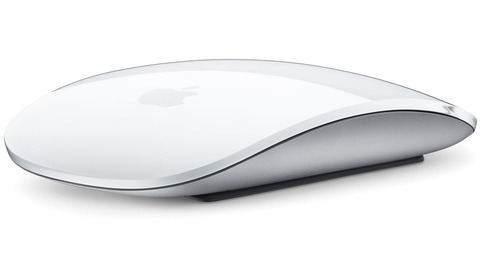
Magic Mouse From Apple
A new computer mouse is generally an afterthought—a new shade of pink, a slightly more ergonomic form—but Apple’s new Magic Mouse takes a step further by imitating the touch-screen experience of an iPhone.
Without any physical buttons, the input device—available for $69—is itself the button, Apple said. Using technology employed on the iPhone and iPod Touch, the top of the Magic Mouse is a sensor that reads touch gestures to scroll, pan, swipe and click on documents and in applications. Earlier iterations of Apple mice were criticized for a rather sloppy feel and loose fit.
The new device is Bluetooth-enabled for wireless use, and Apple said it’s equally friendly to either left or right hands. But it will work only with Macs running Leopard version 10.5.8 or later; Windows users need not apply.
Magic Mouse also ships with a new range of desktop iMacs, announced Tuesday, as was an updated, bottom-of-the-line MacBook for $999.
The new iMacs’ LED-backlit displays come in either 21.5 or 27 inches. They start at $1,199 with Intel Core 2 Duo 3.06 GHz chips. The 27-inch display is fairly massive even for a giant desktop, and Apple said it displays 2560-by-1440 pixel resolution, which should translate to a stunning image—from about four feet away. It ships with a wireless keyboard should users care to kick back. That Mac sells for $1,699.
The new MacBook inherits the 13.3-inch LED-lit screen from its MacBook Pro siblings as well as a longer-life, seven-hour battery, but keeps a polycarbonate (rather than aluminum) housing and its price tag of $999. It ships with a 2.26 GHz Intel Core 2 Duo processor, 2 gigabytes of RAM, and a 250-gigabyte hard drive.
Hard Drive Full? Archive Some Photos
The My Pictures folder on my Mac notebook holds a whopping 47.39 gigabytes of images. It’s nice to have so many photos of people, places and trips — except for the unfortunate fact that they consume about one quarter of my total hard drive space. And I am running very short on storage these days.
A good way to free up hard drive space is to offload photos to an external drive or burn them to DVD (if you don’t have an external drive). Here are methods to delete images from iPhoto for Mac users as well as from Adobe Photoshop Elements for Windows users.
First the Mac. If you want to duplicate the entire iPhoto library, which is a self-contained file on your hard drive, you can create an archived copy by simply dragging the library (it’s located in the Pictures folder) to another hard drive. This preserves all the information in the library, including Faces, Places, albums and slide shows. This duplicate library can be opened on any other Mac that runs iPhoto.
If you want to archive only parts of your iPhoto library, you can burn them to a DVD and then copy the DVD to another hard drive (not the most elegant of solutions, but it works). In iPhoto, select the Events you want to copy, then click the Share menu, then Burn. This iPhoto library on DVD can be viewed on any Mac using iPhoto. This method also saves all the photo metadata and other info from iPhoto. If you don’t copy the DVD to a hard drive, it’s a good idea to burn multiple copies of the DVD, just to be safe.
Finally, if you want to archive photos that can be opened without iPhoto on any computer (I’d choose this option), you can export the images to an external drive. In iPhoto, click the Events you wish to copy, click the File menu, then select Export. Next, you’ll see an Export Photos dialog box. Click Original in the Kind pop-up menu. If you also want to preserve your images with editing applied, choose File, then Export, and then choose JPEG in the Kind pop-up menu and Full Size in the Size pop-up menu in the Export Photos dialog.
After you’re done, you still have to delete the images from the iPhoto library as well as the computer’s hard drive. Identify the images you want to delete, then click Command/Option Delete. You must then empty the iPhoto’s trash, which you’ll find under the iPhoto menu.
Users of Adobe’s Photoshop Elements 8 get 2 gigabytes of free online storage (the Pro version gives you 20 gigabytes). But if you prefer to keep local copies, it’s easy to do it yourself.
A handy feature of Elements is that moving files removes them from the library but leaves a preview file in Elements, which shows the photos but requires you to navigate to the location to which it has been moved to retrieve the full image.
To burn to a CD or DVD, click the File menu, then Copy/Move to Removable Disk. Select Move Files, then Next. The software will ask you to select a destination drive (the default is the CD/DVD burner on your PC). Insert a disc, name the disc, click Done and it writes the photos to the disc.
To copy files to an external hard drive, open the Organizer and select the files or catalogs you want to copy. Select the File menu, then Move. You’ll click Browse in the Move Selected Items dialog box and locate and select the folder into which you want to move the media files. Click O.K. and the transfer begins.
After you move the images, you’ll then need to delete them from Elements and your hard drive. Select the images, click Delete, then click the box that says “Also delete selected item(s) from the hard disk.”
Storing old photos on an external drive or DVDs is a great disk-cleanup exercise. I’ve regained more than 6 gigabytes, and I’m not done yet.
Story: New York Times
A good way to free up hard drive space is to offload photos to an external drive or burn them to DVD (if you don’t have an external drive). Here are methods to delete images from iPhoto for Mac users as well as from Adobe Photoshop Elements for Windows users.
First the Mac. If you want to duplicate the entire iPhoto library, which is a self-contained file on your hard drive, you can create an archived copy by simply dragging the library (it’s located in the Pictures folder) to another hard drive. This preserves all the information in the library, including Faces, Places, albums and slide shows. This duplicate library can be opened on any other Mac that runs iPhoto.
If you want to archive only parts of your iPhoto library, you can burn them to a DVD and then copy the DVD to another hard drive (not the most elegant of solutions, but it works). In iPhoto, select the Events you want to copy, then click the Share menu, then Burn. This iPhoto library on DVD can be viewed on any Mac using iPhoto. This method also saves all the photo metadata and other info from iPhoto. If you don’t copy the DVD to a hard drive, it’s a good idea to burn multiple copies of the DVD, just to be safe.
Finally, if you want to archive photos that can be opened without iPhoto on any computer (I’d choose this option), you can export the images to an external drive. In iPhoto, click the Events you wish to copy, click the File menu, then select Export. Next, you’ll see an Export Photos dialog box. Click Original in the Kind pop-up menu. If you also want to preserve your images with editing applied, choose File, then Export, and then choose JPEG in the Kind pop-up menu and Full Size in the Size pop-up menu in the Export Photos dialog.
After you’re done, you still have to delete the images from the iPhoto library as well as the computer’s hard drive. Identify the images you want to delete, then click Command/Option Delete. You must then empty the iPhoto’s trash, which you’ll find under the iPhoto menu.
Users of Adobe’s Photoshop Elements 8 get 2 gigabytes of free online storage (the Pro version gives you 20 gigabytes). But if you prefer to keep local copies, it’s easy to do it yourself.
A handy feature of Elements is that moving files removes them from the library but leaves a preview file in Elements, which shows the photos but requires you to navigate to the location to which it has been moved to retrieve the full image.
To burn to a CD or DVD, click the File menu, then Copy/Move to Removable Disk. Select Move Files, then Next. The software will ask you to select a destination drive (the default is the CD/DVD burner on your PC). Insert a disc, name the disc, click Done and it writes the photos to the disc.
To copy files to an external hard drive, open the Organizer and select the files or catalogs you want to copy. Select the File menu, then Move. You’ll click Browse in the Move Selected Items dialog box and locate and select the folder into which you want to move the media files. Click O.K. and the transfer begins.
After you move the images, you’ll then need to delete them from Elements and your hard drive. Select the images, click Delete, then click the box that says “Also delete selected item(s) from the hard disk.”
Storing old photos on an external drive or DVDs is a great disk-cleanup exercise. I’ve regained more than 6 gigabytes, and I’m not done yet.
Story: New York Times
PC Laptop Guide - Microsoft Stores vs. Apple Stores
Apple Readies New N.Y. Store, Microsoft Mum About Retail Plans
Apple plans to open an additional retail store in New York on Nov. 14, and says it will open 40 to 50 stores worldwide in 2010. Although Microsoft has said it will challenge Apple aggressively in the retail space, comments from Microsoft spokespeople seem to indicate that a wait-and-see approach will follow the October opening of its retail locations in Scottsdale, Ariz., and Mission Viejo, Calif.
Apple plans to rapidly expand its retail footprint, with 40 to 50 stores set to open worldwide in 2010. The majority of those storefronts will be opened in various international locations such as London, Paris and Shanghai, according to a Nov. 12 report from Reuters.
The new locations, including a planned store in the Louvre, will add to the 280 stores that Apple already has in place, three of them in Manhattan. The information about the company's retail plans was revealed in connection with Apple's new outlet on Manhattan's Upper West Side, which is opening on Saturday, Nov. 14, at 10 a.m. ET.
Like Apple's Fifth Avenue location, the Upper West Side store is a building-sized glass box; but unlike that store, where both the retail and Genius Bar reside underground, the new one will feature retail at ground level and the Genius Bar in a basement area.
Apple's announcement of its plans comes a few weeks after Microsoft opened its second retail location, in Mission Viejo, Calif. Microsoft opened its first store on Oct. 22 in Scottsdale, Ariz. Despite earlier saying it would pursue an aggressive retail strategy, Microsoft seems to have toned down some of its rhetoric in that department.
"We plan to open additional stores in the future," a Microsoft spokesperson told eWEEK when approached for comment. "For now, though, we will open these first two stores, listen to and learn from consumers, evolve the model, and open additional stores as quickly as it makes business sense."
The Microsoft store in Mission Viejo shares a mall with an Apple outlet—currently closed for renovations—making head-to-head comparisons between the two tech giants' retail efforts inevitable, at least on a local level.
Microsoft hired George Blankenship, a former Gap executive who helped launch Apple's retail efforts in 2001, to help with its stores. During Microsoft's Worldwide Partner Conference in New Orleans in July, the company suggested that it would assume a more directly competitive stance against Apple.
"We're doing stuff and we're in the game and continuing to take some of these hard market-share opportunities head-on and compete because it's a test of will," Microsoft Chief Operating Officer Kevin Turner told an audience during the conference, describing his company as "on the offensive" against Apple. He was followed by Microsoft CEO Steve Ballmer, who suggested that PCs running Windows were regaining share in the PC market at Apple's expense.
"All of our research shows that our 'I'm a PC' ads—that talk dramatically about the price of Macintoshes—work quite effectively," Ballmer said during a Q&A session following his July 14 keynote speech at the event. "We've gained market share quite effectively against Apple over the past six to nine months."
According to statistics company Net Applications, Windows 7's share of the overall PC market rose to 7 percent by Nov. 9, not long after the operating system's Oct. 22 release. Net Applications' most recent report suggested that Microsoft currently holds 92.52 percent of the operating-system market between its various versions of Windows, while Apple holds 5.27 percent and Linux occupies 0.96 percent.
Whether Microsoft will be able to reverse a declining revenue trend in 2010, though, is largely dependent on sales of PCs and other IT equipment over the next few quarters. By contrast, Apple has managed to weather the economic recession in good form, reporting fiscal fourth-quarter results on Oct. 19 that surpassed Wall Street expectations with revenue of $9.87 billion and a net quarterly profit of $1.67 billion.
Apple reportedly earned $3 billion from its retail operations for the first six months of 2009, and Bloomberg estimated that its Fifth Avenue location could have annual sales of $350 million or more.
When contacted by eWEEK previously about the possibility of Microsoft opening a New York location, a spokesperson deferred comment. Microsoft's Arizona and California stores saw a flood of customers during their opening days, likely drawn by the enticements of substantial discounts on electronics and free concert tickets; it is too early to tell, though, how those stores will fare in the long term.
Story from eweek.com
Apple plans to open an additional retail store in New York on Nov. 14, and says it will open 40 to 50 stores worldwide in 2010. Although Microsoft has said it will challenge Apple aggressively in the retail space, comments from Microsoft spokespeople seem to indicate that a wait-and-see approach will follow the October opening of its retail locations in Scottsdale, Ariz., and Mission Viejo, Calif.
Apple plans to rapidly expand its retail footprint, with 40 to 50 stores set to open worldwide in 2010. The majority of those storefronts will be opened in various international locations such as London, Paris and Shanghai, according to a Nov. 12 report from Reuters.
The new locations, including a planned store in the Louvre, will add to the 280 stores that Apple already has in place, three of them in Manhattan. The information about the company's retail plans was revealed in connection with Apple's new outlet on Manhattan's Upper West Side, which is opening on Saturday, Nov. 14, at 10 a.m. ET.
Like Apple's Fifth Avenue location, the Upper West Side store is a building-sized glass box; but unlike that store, where both the retail and Genius Bar reside underground, the new one will feature retail at ground level and the Genius Bar in a basement area.
Apple's announcement of its plans comes a few weeks after Microsoft opened its second retail location, in Mission Viejo, Calif. Microsoft opened its first store on Oct. 22 in Scottsdale, Ariz. Despite earlier saying it would pursue an aggressive retail strategy, Microsoft seems to have toned down some of its rhetoric in that department.
"We plan to open additional stores in the future," a Microsoft spokesperson told eWEEK when approached for comment. "For now, though, we will open these first two stores, listen to and learn from consumers, evolve the model, and open additional stores as quickly as it makes business sense."
The Microsoft store in Mission Viejo shares a mall with an Apple outlet—currently closed for renovations—making head-to-head comparisons between the two tech giants' retail efforts inevitable, at least on a local level.
Microsoft hired George Blankenship, a former Gap executive who helped launch Apple's retail efforts in 2001, to help with its stores. During Microsoft's Worldwide Partner Conference in New Orleans in July, the company suggested that it would assume a more directly competitive stance against Apple.
"We're doing stuff and we're in the game and continuing to take some of these hard market-share opportunities head-on and compete because it's a test of will," Microsoft Chief Operating Officer Kevin Turner told an audience during the conference, describing his company as "on the offensive" against Apple. He was followed by Microsoft CEO Steve Ballmer, who suggested that PCs running Windows were regaining share in the PC market at Apple's expense.
"All of our research shows that our 'I'm a PC' ads—that talk dramatically about the price of Macintoshes—work quite effectively," Ballmer said during a Q&A session following his July 14 keynote speech at the event. "We've gained market share quite effectively against Apple over the past six to nine months."
According to statistics company Net Applications, Windows 7's share of the overall PC market rose to 7 percent by Nov. 9, not long after the operating system's Oct. 22 release. Net Applications' most recent report suggested that Microsoft currently holds 92.52 percent of the operating-system market between its various versions of Windows, while Apple holds 5.27 percent and Linux occupies 0.96 percent.
Whether Microsoft will be able to reverse a declining revenue trend in 2010, though, is largely dependent on sales of PCs and other IT equipment over the next few quarters. By contrast, Apple has managed to weather the economic recession in good form, reporting fiscal fourth-quarter results on Oct. 19 that surpassed Wall Street expectations with revenue of $9.87 billion and a net quarterly profit of $1.67 billion.
Apple reportedly earned $3 billion from its retail operations for the first six months of 2009, and Bloomberg estimated that its Fifth Avenue location could have annual sales of $350 million or more.
When contacted by eWEEK previously about the possibility of Microsoft opening a New York location, a spokesperson deferred comment. Microsoft's Arizona and California stores saw a flood of customers during their opening days, likely drawn by the enticements of substantial discounts on electronics and free concert tickets; it is too early to tell, though, how those stores will fare in the long term.
Story from eweek.com
Subscribe to:
Posts (Atom)
Followers
Blog Archive
-
▼
2009
(11)
-
▼
November
(11)
- Beyond Gaming: Watching TV on Your Xbox
- Price Is Heavier, but These Laptops Are Very Sleek
- Windows 7 - Reviews
- Window 7 - Reviews
- Microsoft - Windows 7 Review
- Microsoft Launches Windows 7
- Operating Systems Offer New Choices in PC Shopping
- Apple’s Modest Addition to the Upper West Side in ...
- Magic Mouse From Apple
- Hard Drive Full? Archive Some Photos
- PC Laptop Guide - Microsoft Stores vs. Apple Stores
-
▼
November
(11)